Begin Reading

Mettwurst Recipe

servers 125 centimetres a week, 65 metres a year and 5 kilometres a lifetime

ingredients

  • offal (bits of lung, scraps of liver, blood, brain fat)
  • discarded meat
  • spices (garlic, coriander, all spice)
  • fibre/binding agent/egg
  • intestines for casing and digestion
  • a white layer of mould
  • microorganisms (lactic bacteria for acidity and staphylococcus bacteria for flavor)
  • equipment

Step 1
mince and cut the offal and discarded meat – the shit

Step 2
Artificial Predigestion: add the spices, mix and knead by hand to ensure even distribution.

Step 3
remove water, to keep firm particles have to stick together, add the fibre or binding agent of your choice or mix in an egg
done right a good solid turd should have the consistency of 20% dry matter, to increase productivity water it down to 10% and your shit output will be in the bouillons!

Step 4
Stuffing: stuff the filling into the intestines, the ultimate pig in sheep’s clothing, if the filling turns out well you can turn it into any shape, but the best shape is worm shape
what kind of sausage is it?
is it too hard?
is it too soft?
or as goldie locks would say is it just right??
if the sausage filling is too thick you won’t be able to stuff it into its casing
too dry filling crumbles like sand
cohesion determines its length, the softer the shit, the shorter the turd
diarrhea results in a bowl full of sludge or a pile of pellets

Step 5
Ripening: add the bacteria and mould and your sausage is set

Backyard Sewer

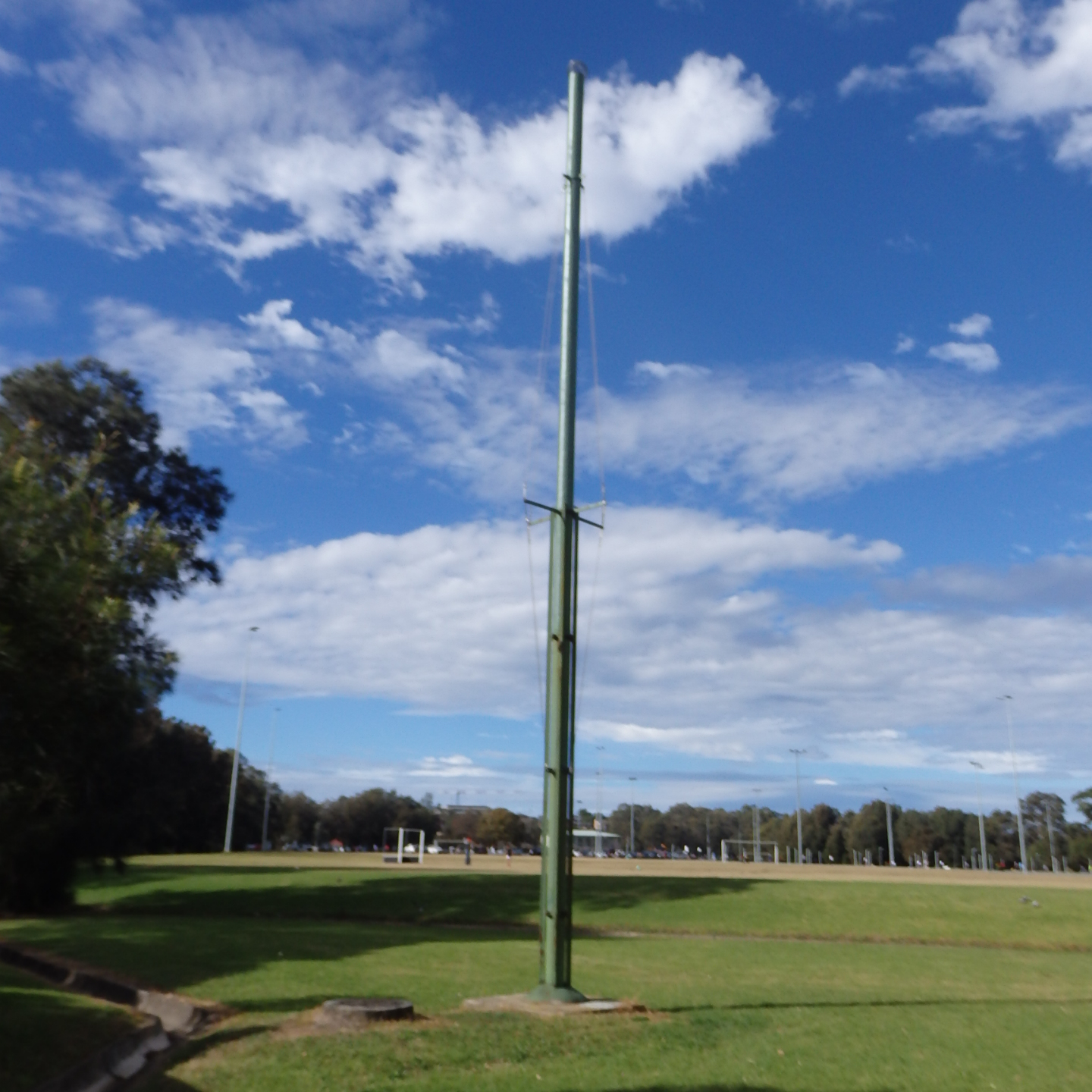
While walking my dog in the park yesterday, I noticed of all things a sewer vent. The park where I live is composed of thirteen sporting fields, numerous netball courts, a basketball court, a dog park, four separate play equipments and three car parks. The sewer vent is thirteen backyards from mine, though from the house side of the street you can’t see it. Our street is a cul de sac, the end of it curves directly into the dog park, allowing the sewer vent to discreetly peek-out behind the last house on our side of the street. From where it is situated in the park, a open field on the edge of the dog park and next to the twelfth sporting field, and being green the vent almost seamlessly blends into the greenery, despite being a tall pole.
Unlike the glorified Hyde Park Obelisk, Meadowbank sewer vent is a pole with a sewer hole next to it. Being a pole of course serves, to help it blend in with all the miscellaneous utility poles around the suburb and there are many. From street lights to sport field lights, to the poles supporting overhead power lines and the numerous street signs (which even so there never seems to be enough of those). However on closer inspection it appears shorter than the other poles (not counting the street signs), I would estimate that is is between five and nine metres in height.

What led me to discovering it, initially was the smell, a salty dank scent. Suspiciously pungent and familiar. Reminding me of mangroves, the sea and the smell from the Sewage Treatment Plant though on a considerably smaller scale. The smell appears to be coming from the covered sewer hole next to the vent, which begs the question what is the point of a useless utility pole?
The second thing I noticed on closer inspection was the noise, not from the vent itself, but again from the covered sewer hole. A surging, gurgling, bubbling, churning noise of water in constant flow. Much like a tap on full blast or a bubbling, brewing stew and rain as it’s pissing down hard. Another major difference to the Hyde Park Obelisk is the sensorial atmosphere, the smell and the noise have a real presence that doesn’t exist in Hyde Park where the Obelisk is easily mistaken to be part and parcel of the War Memorial simply by being near it and of monumental height.
It is true that both the smell and noise of the Meadowbank vent are quite subtle, only audible within five metres and smells at about three metres distance. I have walked past the sewer vent, walked in Meadowbank park almost my entire life, of course not everyday. I’m sure I’ve seen it before, just never quite put two and two together to really figure out what it was, a classic case of out of sight out of mind.

A Sizable Condom

“Turn lots of heads and raise a few eyebrows” – Nicholas Parkhill.

It’s the erection that Sydney has the world talking about.

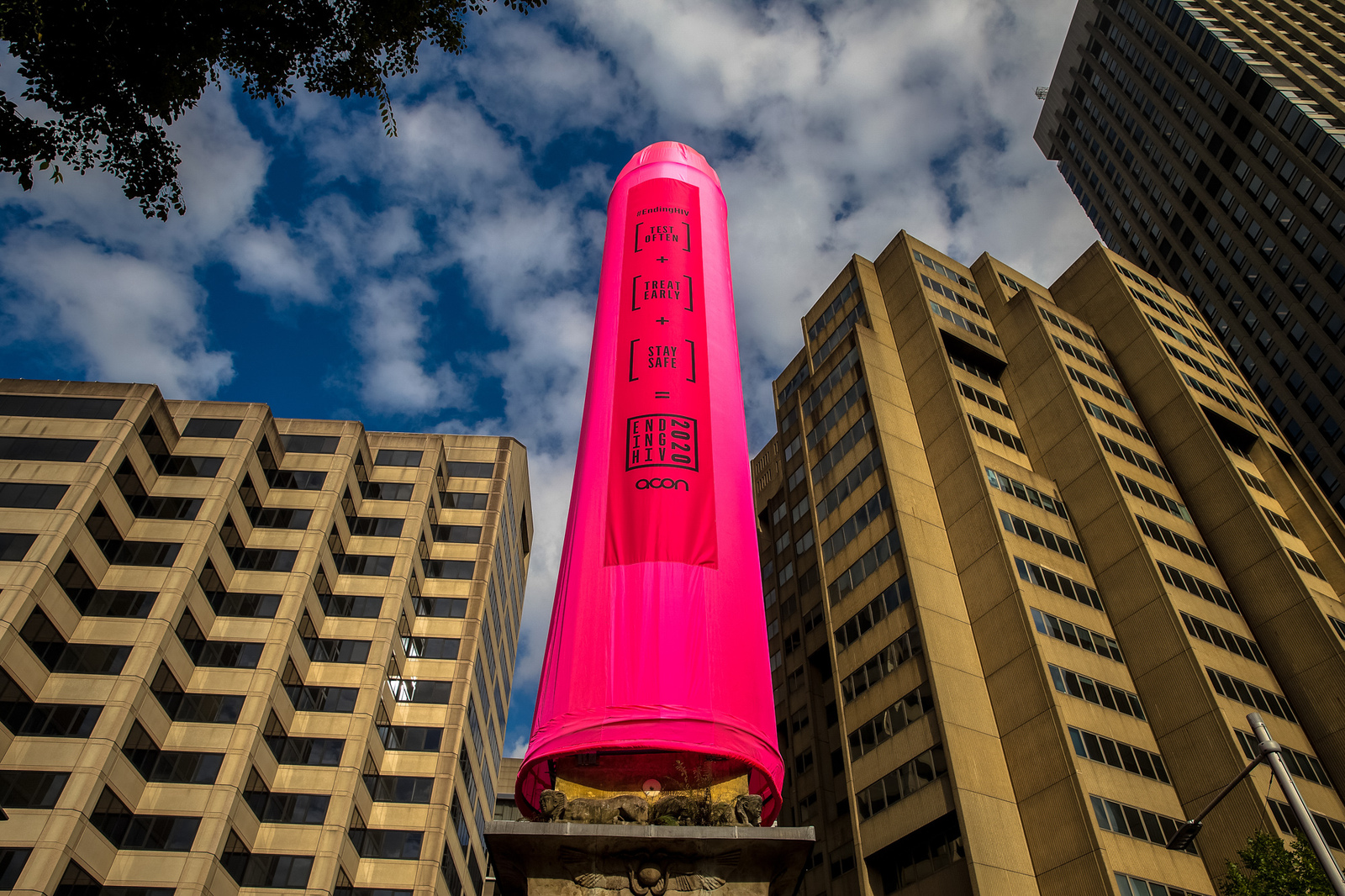
On the 7th November 2014, the Hyde Park Obelisk had an 18 metre pink condom erected as part of a campaign “I’m ON” to promote HIV awareness. ACON is a health promotion organization that focuses on HIV and Aids, lesbian, gay, bisexual and transgender health.
Mounted over night by crews of hard-hat tooting workers, it stood for a week an impressive performance.
Passers-by stopped to take pictures and discuss the new arrival.
People turned to social media.

Annie Armenian@anniea89 – “@BuzzFeedOz: Uh guys. Guys. What. RT @emilywilson: Sydney! pic.twitter.com/4mQvvkURWR” I, for one, welcome our new condom overlords

Senthorun Raj – So, I’m off to see the #GiantCondom in Sydney. Because, if there’s one thing as titillating as an inflatable butt plug, it’s a pink condom!

2DayFM Breakfast – Now THIS got our attention – http:/t.co/iaHRkJmcBL Always use protection… even if you’re a monument pic.twitter.com/6zRlpQ7UG6

Kemal Atlay – I wonder what flavor the Hyde Park #giantcondom is…

One passer- by “Oh my god – that is crazy. It’s the first time I’ve ever noticed it, at least it adds a bit of colour.”

When in fact the condom serves to highlight the phallic nature of all Obelisks at large, just as Edouard Manet’s Olympia shined a glaring light on the pornographic nature of the nude.

Jackson Long – #GiantCondom this is fantastic! Well done http://endinghiv.org.au . And Sydney Water for allowing this to happen.

But of course not all the public were pleased by the stimulating installation.

Wendy Francis, Australian Christian Lobby director and outdoor advertising lobbyist – “Parents do not want to be forced into a situation where they have to explain something that’s not relevant. It’s an Obelisk and we’re turning it into a penis.”

However ACON was not the first organization, nor was the Hyde Park Obelisk the first Obelisk to be bedecked with a giant rubber glove.

1993 HIV had infected 14 million people and AZT resistant strains of HIV began to emerge. ‘Time to Act’ was the theme of the 1993 World AIDS Day. ACT UP Paris took it literally with financial support from The United Colors of Benetton executed “operation giant condom”, commando style, in the middle of Paris’ most public square.

Within a matter of minutes one of the three actual Cleopatras’ needles in the centre of the Place de la Concorde was transformed from a monument into a symbol of awareness and prevention. It was only in place for mere moments before authorities ordered it to be removed, that didn’t prevent it from making ripples around the world.

“Wanted to show that AIDS was a problem that penetrated society” – Mariana Galanti.

Even monuments practice safe sex.

The Place Is

The place is.
The place is Aboriginal Land.
The place is Gadigal land.
The place is stolen land.
The place is Australia.
The place is New South Wales.
The place is a city.
The place is Sydney.
The place is Gadigal land.
The place is the city.
The place is a park.
The place is Hyde Park, bares the colonial name steeped in colonial history and lineage of London’s Hyde Park from Governor Lachlan Macquarie.
The place is Hyde Park, the year is 1788.
The place is not a park.
The place is a significant site for Aboriginal contests and is being used as a site of assembled order for colonial soldier assemblies.
The place is Hyde Park, the year is 1792 to 1810.
The place is not a park.
The place is stolen land, property of the crown.
The place is stolen land for use by colonists as a common for gathering firewood, grazing animals, playing cricket and racing horses.
The place is Hyde Park, the years are 1810 to 1927.
The place is Hyde Park, designed by Norman Weekes, Sir John Sulman, Alfred Hook, W. G. Layton and I. Berzins.
The place is becoming a park.
The place is Hyde Park, of today it is located on the eastern fringe of the Sydney city centre.
The place is Hyde Park, of today it is located in the central business district of Sydney, in the City of Sydney local government area of New South Wales.
The place is Hyde Park surrounded on the west by Elizabeth Street, on the east by College Street, on the north St. James and Prince Albert Roads and the south by Liverpool Street, and Park Street cuts through the middle.
The place is Hyde Park surrounded by the David Jones Limited flagship store and the CBD to the west, St. Mary’s Cathedral, the Australia Museum and Sydney Gramma School to the east, the Supreme Court of New South Wales, St. James Church, Hyde Park Barracks and Sydney Hospital to the north, and the Downing Centre to the south.
The place is Hyde Park the home of the Obelisk affectionately known as Thornton’s Scent Bottle, the first civic monument, the first special sewer ventilating shaft and the oldest piece of existing ornamental infrastructure.
The place is the design and placement of the obelisk was used to understand the behaviour of gases within the sewerage system and how to best design vents with safety in mind.
The place is important in demonstrating the course, the pattern of cultural and natural history displays the classical architecture and technology of the late 19th century.
The place is the Obelisk is a Landmark feature within Hyde Park and Sydney, recognizable from a distance, and a popular meeting place in the CBD.
The place is the site that the Obelisk stands on, known as Hyde Park, at the junction of Bathurst Street and Elizabeth Street.
The place is richly steeped in colonial history.
The place is still unrepatriated.
The place is.

Poetic Shit

solid street
solid
lid
put the lid on the dunny
don’t stink it out
smell
scent
visaraille
pungent
salty stench
poo


walk the renewable walk
single file
tour minions
playing follow the leader
don’t drink
I’ve lost my denture, have you seen them?
human impact
is that shit recycled?


tertiary lane
a third stage
sedimentation
sludge & scum
scum & sludge
anaerobic digestion
microorganisms
gonna have me some shit tonight


odour control drive
odour
aroma
constraint
constrict
confined space
it’s a con
politics of shit
public policy
deodorant or bo
freedom to stink
who did it?

In Plain Site

When walking from the north-east corner of Hyde Park through the park towards Bathurst Street, whether walking across the pavers, bark chips or grass, you will walk past trees, the war memorial and as you do you will notice what looks like a sandstone plinth in the distance but it’s obscured by trees that you are yet to pass. All around you people are going about their own business and there is the constant sound of sirens and traffic either flowing or stalled. When flowing the engines roar like the ocean, churning as wheels turn.

The closer you get the more you notice, that there is text on the sandstone plinth but it’s yet too far away to read and through the trees you see what could be the sandstone shaft. Though the thick foliage of the trees still obstructs your view, veering to the right you see just above them the pointy decorative metal top of what could be a tower roof or an oversized ornamental arrow pointing up at the sky.

It is only at 50 metres distance that the sphinxes are visible and the writing intelligible. A few more metres and the Hyde Park Obelisk is unveiled in all its glory; sandstone base with Egyptian ornamentation, the sandstone shaft and the topper a filigree bronze pyramid thrusting into space. Standing a full 22 metres it dwarves the surrounding trees (when not on a slop) but is itself dwarfed by the modern buildings. All the buildings along Elizabeth Street between Liverpool Street in the north and Park Street in the south appear to be either offices, retail shops or cafés with large windows; all the better to ogle at a model in phallic architecture.

When in Bathurst Street facing Hyde Park although the top of the Obelisk is veiled by trees, like a phallus obscured but thick bush the base is clear and obvious, sandstone contrasting with the greenery behind it. The closer you get to the intersection of Bathurst Street and Elizabeth Street the quicker it becomes completely visible, thrusting above all the trees at monumental scale. Walking down Elizabeth Street via Liverpool Street or walking up Elizabeth Street from Park Street you notice it quickly, by virtue of it being in the middle of your walk way. In actual fact not trees or foliage or other constructions are directly next to the Hyde Park Obelisk on any side. It is a large scale sculptural monument, almost a stand-alone duck.

People stand next to the Obelisk, walk by it, stare at it in their cars whilst waiting to turn left or right from Bathurst Street on to Elizabeth Street and pass it by without a second thought. Two men are standing under it, deep in conversation for the last twenty minutes I’ve been writing this, only to suddenly part ways. One crosses to Bathurst Street and the other walks down Elizabeth Street, presumably towards Park Street to catch a bus? Tourists photograph the Obelisk blissfully unaware; a couple sits on a step 5 metres from it to stare at their mobiles. A man slowly saunters past it, only to change his mind and walk back the way he came up Elizabeth Street towards Liverpool Street. Six people wait at the lights; twenty people sit at the small tables in the Starbucks across the street guzzling their lattes, expressos or cappuccinos, all the office workers type away at their macs or pcs, and the retail workers palm off this season’s latest must haves. At least forty people have paused to rest, passed by and met up and move on under the Obelisk as I’ve been sitting here writing this, all of them unconscious of the history they just walked on.

Fat Burger – Fatberg

serves 4, 944, 000

ingredients

  • food waste
  • rubbish (apple stickers)
  • f.o.g. (fats, oils & grease)
  • cotton buds
  • wet wipes (the flushable kind)
  • nappies (the sloppier the better)
  • tampons
  • pads & their wrappers
  • condoms
  • flushing toilets (get your neighbours in on the fun)
  • equipment

Step 1
gather bulk amounts of the ingredients and flush them down multiple toilets continuously, forming a soggy and compact mass in the pipes

Step 2
anonymously inform Sydney water of what should be an approximately one tonne gloopy conglomerate

Step 3
using a combination of shovels, pickaxes, buckets, pressure cleaning equipment and a crane remove the sloppy burger or ‘fatberg’

Sewer System

There are three types of Sewerage Treatment Plants; primary, secondary and tertiary.

Primary & discharge locations:
Bellambi – Bellambi Point
Bondi – Deepwater ocean 2.2km
Fairfield – Orphan School Creek to Georges River
Malabar – Deepwater ocean 3.6km
North Head – Deepwater ocean 3.7km
Port Kembla – Red Point

Secondary & discharge locations:
Shellharbour – Offshore outfall 130m from Barrack Point
Warriewood – Turimetta Head

Tertiary & discharge locations:
Brooklyn – Hawkesbury River, Brooklyn
Cronulla – Potter Point, Kurnell
Hornsby Heights – Calna Creek to Berowra Creek
North Richmond – Redbank Creek to Hawkesbury River
Riverstone – Eastern Creek to South Creek
Wallacia – Warragamba River
Warriewood – Turimetta Head
West Hornsby – Waitara Creek to Berowra Creek
Wimmalee – Unnamed Creek to Nepean River

In total seventeen Sewerage Treatment Plants in New South Wales, a daunting task to attempt to visit them all and still manage to meet my art school commitments. In the Sewerage System there is more utilities than just Sewerage Treatment Plants. Such as Sewerage Treatment Ponds, Sewerage Pumping Stations, Sewer Mains, The Sewerage Transportation Systems and Sewer Vents.

Modern Sewer Vents come in nine different styles but invariably they are all long shafts ranging from nine to Thirty metres in height, and either free standing structures or wall bound. In the centre of Sydney there is a unique Sewer Vent the Hyde Park Obelisk or as it is affectionately known ‘Thornton’s Scent Bottle’. Located at the junction of Bathurst and Elizabeth Street, standing a full twenty two metres high the Hyde Park Obelisk was completed in 1857. Sydney’s first civic monument in honour of the mayor at the time George Thornton, a classy gesture turned on its head with a dual role as a vent for Sydney’s first sewage system. It is the only sewer vent shaft still built of sandstone left, a relic, modelled after Cleopatra’s Needle a gift to England. Complete with matching sphinxes the Hyde Park Obelisk has a filigree bronze pyramid the vent.

Mud Cake

serves 250, 000 people

ingredients

  • water (used)
  • food scrapes
  • fog (fats, oil & grease)
  • rubbish (apple stickers)
  • 1% poo, pee and vomit
  • toilet paper
  • tampons, pads & their wrappers, condoms
  • dental floss
  • cotton buds
  • tissues
  • wet wipes
  • hair
  • nail clippings
  • grit like sand, dirt and dust
  • soaps, shampoos & conditioner
  • detergent, dishwasher tablets & floor cleaner
  • harsh chemicals (paint, solvents, pesticides)
  • toys (lego, barbie doll legs)
  • dentures
  • high concentration of micro organisms
  • machinery

Step 1
remove large solids through the physical separation – screenings

Step 2
filter dirt particles with jets of air

Step 3
Sedimentation: scrape the fog (fats, oils & grease) from the top – the sludge and the scum – (poo) from the bottom

Step 4
Bio Reactor: add high concentrations of microorganisms and vary the amounts of air in the tank

Step 5
using high speed centrifuges remove the remaining water & compress the bio waste into cake

Words on Waste

1% POO
ANAEROBIC DIGESTER
BACK WASH, BIO REACTOR, BIO SOLIDS, BIO WASTE
CONFINED SPACE , COTTON BUDS , CLARIFIER
DENTURES , DON THE BUS DRIVER
ODOUR CONTROL DRIVE
DO NOT DRINK (THE WATER), DON THE BUS DRIVER
“ENVIRONMENT”
F.O.G (fats, oils & greases), FOOD WASTE , FOUL AIR
HUMAN IMPACT
MUD CAKE, MUST FACE LADDER WHEN DESCENDING
POLITICS OF POO, PROBE
RECLAIMED EFFLUENT, RENEWABLE WALK
SANITISATION, SANITATION, SCRAPER ARM, SCREENINGS, SEDIMENTATION, SLUDGE – WATER – SCUM SOLID STREET
TERTIARY LANE
VORTEX
WASTE WATER, WET WIPES

While on the tour of the Cronulla Sewage Treatment Plant we couldn’t help noticing the street and equipment signs, and parts of the tour spiel, particular words and phrases that popped out at us (as you can see listed above).
What surprised me at the most at the end when asked “What was the weirdest things people had flushed down the drain?” Not flinching our tour guide said dentures, legos and barbie doll legs. The thing about the dentures, was that people would actually call if they’d turned up and if they could have them back! I guess that is understandable, considering the expense but all the same. I was shocked because I’d never even thought of trying to flush things, let alone toys down the drain. (What a waste!)

When it came to making an artwork for Drawing Week from the experience, I felt stuck. Although interested and inspired I had no clear direction and Cronulla Sewage Treatment Plant being a secure site (that I don’t actually live near) made it hard to recapture the same impressions.
However I quickly became obsessed with the words sludge and scum, repeating them over and over and over:
SLUDGE SCUM SLUDGE SCUM SLUDGE SCUM SLUDGE SCUM SLUDGE SCUM

As I was repeating the words, I remembered a story my mum told me from when she was younger. She used to play with her younger brothers and they would make “mud pies”, pies of dirt in their backyard. Which reminded me of something our tour guide said about what happens to the sludge and scum once separated from waste water and digested by microorganisms in a bio reactor. Essentially it gets turned into what is called biosolids which we were told “looks just mud cake!” I thought what if I make a “mud cake” recipe? Which sparked the true beginning of my sewage obsession and research.